The Evolution of Payments
Humans have always relied on some system of commerce throughout the ages. People still needed to trade and conduct commerce, so they used other forms of payment to complete transactions. With the evolution of technology, money and payments have entered new frontiers.
Bartering
A barter system is one of the earliest systems used for commerce. During this time, people exchanged services and goods for other services and goods in return. There is evidence to suggest that bartering is not purely a human activity, as it exists in the plant and animal world through symbiotic relationships that have been in existence for millions of years.
Commodity Money
A commodity money system is based upon goods that would have value even if they were not being used as money. Different societies used commodity goods such as salt, tea, cacao beans, and even alcohol as ‘money’. These items were not always easy to carry and could go bad after a while. Eventually, around 600 BCE, the Lydians were among the first civilizations to use coins made of gold and silver. These coins were still considered a commodity system because the value of the metals used to make the coins were equal to the value of the coins. Being able to assign values to the coins, based upon the size and weight of the metal, made it easier for people to compare the value of the coins versus the value of goods and services. This was a major shift due to their value, durability, and portability.
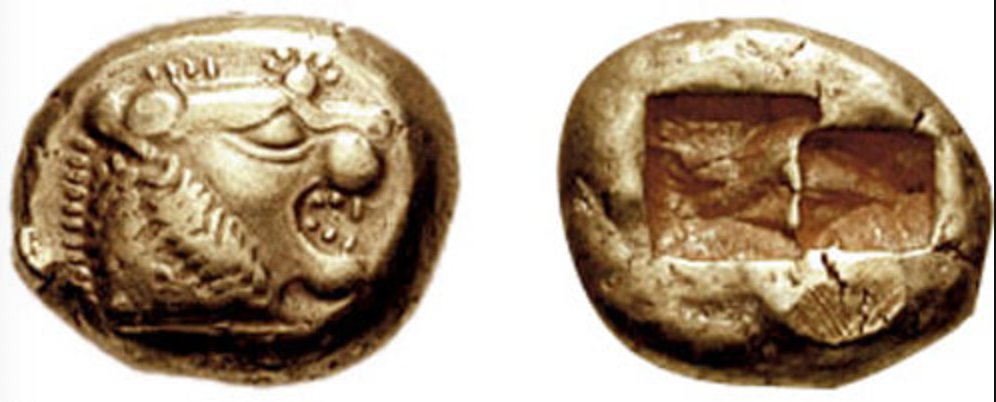 A Lydian electrum coin, c. 600 BCE. Among the first standardized coins ever minted, used in the region of modern day Turkey.
Paper Money
During the Tang Dynasty, China developed paper money, with private bills of credit called “flying money” (fei qian) used by merchants to avoid transporting heavy copper coins. In this money system, each bill represents a value that everyone agrees upon. This is fiat money, which is a currency that a government declares the legal form of money in the country. The currency itself, however, has no real value other than the government’s backing and the trust people place in it. A $100 bill is really just a rectangular piece of special paper. The paper itself is not worth $100, but the bill has a value of $100 because our government says it does.
Digital Money
Up until the 1990s, transactions typically closed with the ceremonial handing over of cash, coin, or check. Money, in some physical form, was always present in the process. The rise of the internet and personal computing changed that. Credit cards, online banking, and payment platforms like PayPal made it possible to transact without physically handling cash. Money was still fiat, still government backed and bank managed, but the way people interacted with it changed dramatically. International payments, once slow and expensive, became faster and more accessible. Tokenised deposits, where banks represent customer funds digitally on internal ledgers, became the norm. Today, most money that exists never takes physical form at all. Although money cannot be conjured out of thin air, it certainly moves through it.

Cryptocurrency
In 2009, Bitcoin introduced a fundamentally different idea: what if money did not need a government or a bank to back it? Built on blockchain technology, Bitcoin is a decentralized currency, meaning no single authority controls it. Instead, trust is established through a distributed network of computers that verify every transaction. This was the inflection point. For the first time, two parties could transact directly without a middleman. Stablecoins emerged as a bridge between the volatility of crypto and the stability of fiat, pegging their value to assets like the US dollar while retaining the benefits of blockchain infrastructure.
Takeaways
Money in itself is not real. It is essentially an IOU, anything generally accepted in exchange for goods and services, so it all boils down to trust. There are various ways that “trust” can be achieved. For example, the Mongols had an effective system of ensuring trust in their paper money system. They paid their soldiers in paper money and if any merchant refused to accept it at face value, the merchant would be executed. It was easy then for people to know that if they accepted the paper money, other merchants down the line would accept it too. Not saying the same strategy needs to be done, but it shows how trust, whether enforced by fear, law, or code, has always been the foundation of any payment system.